AI and Copyright: Who Owns AI-Generated Content?
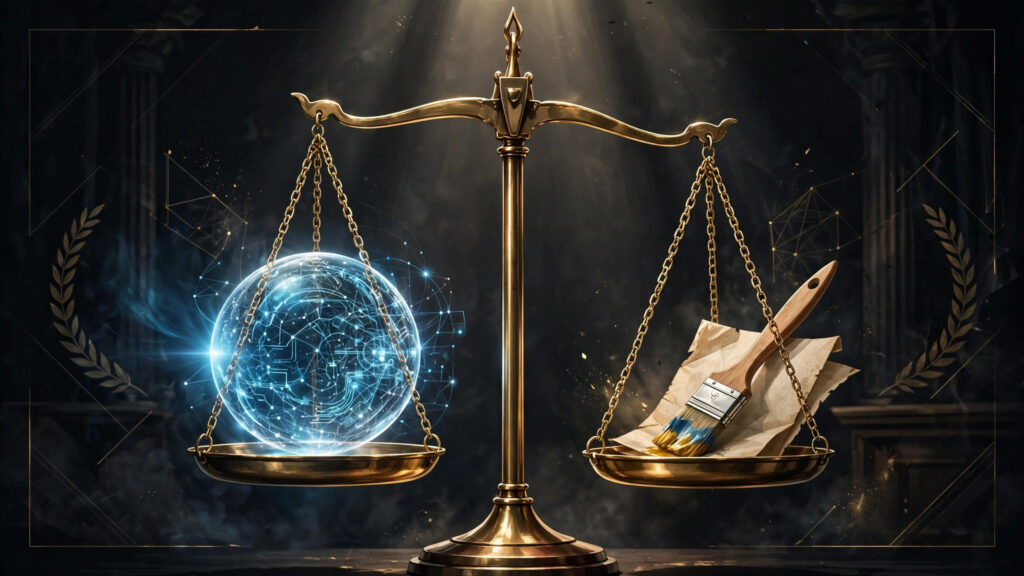
You prompt an image generator, get a stunning artwork, and sell it. Who owns it — you, the AI company, or nobody? The question of AI generated content copyright is one of the most consequential unsettled areas of law, affecting every creator, business, and publisher using generative AI. Here is what the law actually says today — and what remains genuinely uncertain.
Disclaimer up front: this is not legal advice. Copyright law varies by country and is evolving fast; for high-stakes decisions, consult an IP attorney.
AI Generated Content Copyright: What the Law Requires
Copyright’s foundation, in the US and most jurisdictions, is human authorship. The US Copyright Office has been consistent: works created solely by AI, with only a text prompt from a human, are not copyrightable. Its reasoning: a prompt is like instructions to a commissioned artist — you described what you wanted, but the “artist” (the AI) made the creative choices.
The landmark illustration is the Zarya of the Dawn case: the Copyright Office granted copyright for the human-written text and arrangement of a graphic novel but refused it for the AI-generated images within. The principle emerging: human creative contribution is copyrightable; purely machine output is not.
The Gray Zone: How Much Human Input Is Enough?
Most real AI workflows are not “one prompt, done.” Consider the spectrum: a three-word prompt versus fifty iterations of prompting, inpainting, compositing in Photoshop, and manual retouching. The Copyright Office has signaled that substantial human modification and creative arrangement of AI output can qualify for protection — it is the human-authored parts and the creative selection/arrangement that get protected, not the raw AI generation.
This creates a practical strategy for creators: document your process. Save iterations, record your edits, and keep the Photoshop layers. If ownership is ever challenged, evidence of meaningful human creative control is your best asset. The more the final work reflects your choices rather than the model’s defaults, the stronger your claim.
Training Data: The Lawsuits That Could Reshape Everything
The bigger legal battle is not about outputs — it is about inputs. Major lawsuits allege that AI companies infringed copyright by training on copyrighted works without permission. The companies argue fair use: training is transformative, like a human learning from reading books. Rightsholders argue it is mass reproduction for commercial gain.
Outcomes will reshape the industry. If training requires licenses, expect licensed-data models (like Adobe Firefly) to gain advantage and model costs to rise. If fair use prevails, the status quo continues. Either way, indemnification clauses in enterprise AI contracts — where the vendor promises to defend you against IP claims — have become a key purchasing criterion.
AI Generated Content Copyright: Practical Guidance
- Read the terms of service: most AI tools grant you broad rights to use outputs commercially, but the copyrightability of those outputs is a separate legal question the ToS cannot settle.
- Add human creativity: edit, composite, curate, and arrange. Human-directed works with substantial human authorship stand on firmer ground.
- Prefer indemnified tools for commercial work: Adobe, Microsoft, and others offer IP protection for enterprise users — meaningful risk transfer.
- Disclose AI use where required: some platforms and the Copyright Office’s registration process ask about AI-generated content; misrepresentation can void registrations.
- Watch your jurisdiction: the UK, for instance, has a unique provision for “computer-generated works” with different rules than the US.
One more consideration for the AI generated content copyright landscape: contracts between humans often matter more than copyright law itself. If you are a freelancer delivering AI-assisted work to clients, your contract should specify who owns the outputs and who bears IP risk — do not assume default copyright rules cover the AI-specific gaps. Similarly, employers should update IP assignment agreements and freelancer terms to address AI-generated deliverables explicitly, including disclosure obligations and warranties about training-data infringement. As courts slowly fill in the legal blanks, well-drafted contracts are the most reliable protection available today. The businesses navigating this well are not waiting for legal certainty; they are writing their own certainty into agreements, documenting human creative contributions, and choosing indemnified tools for anything that touches revenue.
FAQs
Q: Can I copyright AI-generated art?
A: In the US, purely AI-generated works (prompt-only) are not copyrightable. Works with substantial human creative contribution — editing, arrangement, compositing — can have the human-authored elements protected.
Q: Who owns what ChatGPT or Midjourney creates for me?
A: Their terms generally assign you rights to use the output, but that is a contractual permission — not the same as owning a copyright in it. The copyright question depends on your creative contribution.
Q: Is training AI on copyrighted works legal?
A: Currently being litigated worldwide. Companies claim fair use; rightsholders disagree. No final universal answer exists yet.
Q: Should my business worry about using AI content commercially?
A: Understand the two risks: uncertain ownership of outputs and potential training-data claims. Mitigate with indemnified enterprise tools, human creative input, and legal review for flagship assets.

admin
Tech writer at HubTech Fusion covering the latest in technology, from AI to cybersecurity and beyond.
Related Articles
What Is MLOps? A Beginner’s Guide to Machine Learning Operations
Training a model on your laptop is a data science project. Running that model reliably for millions of users, retraining it as…

Best AI Workflow Automation Tools Compared
Workflow automation grew up: it is no longer just “when X happens, do Y.” The best AI workflow automation tools now embed…

Can AI Search Engines Replace Google? An Honest Look
For the first time in 25 years, Google’s dominance feels contestable. Perplexity, ChatGPT Search, Copilot, and a wave of startups promise a…