What Is MLOps? A Beginner’s Guide to Machine Learning Operations
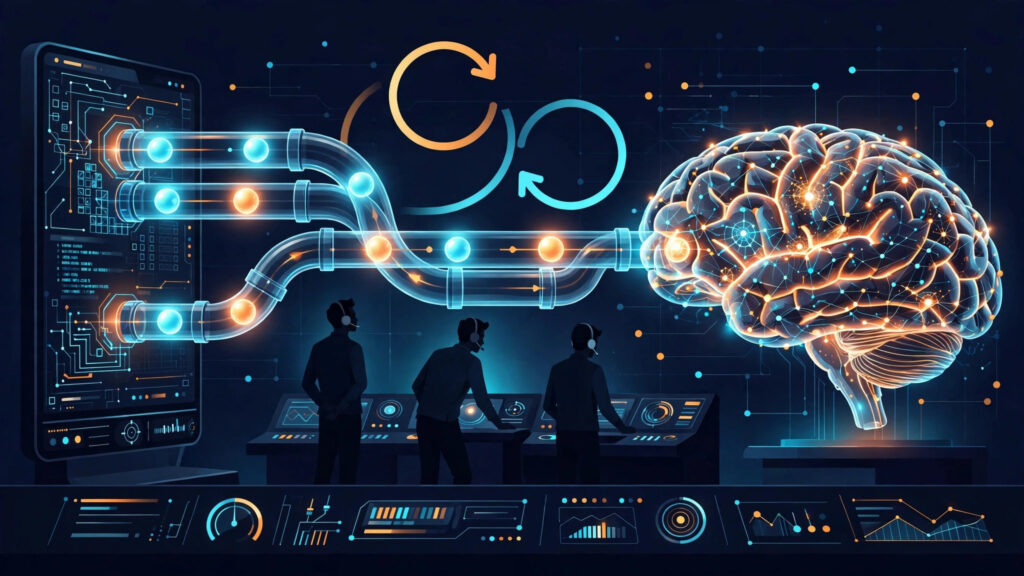
Training a model on your laptop is a data science project. Running that model reliably for millions of users, retraining it as data shifts, and rolling back when it misbehaves — that is an engineering discipline. What is MLOps? It is machine learning operations: the practices and tooling that take models from notebooks to production and keep them healthy there. Think DevOps, adapted for the peculiar challenges of ML.
The motivation is stark: most ML models never reach production, and many that do quietly degrade. MLOps exists to close that gap.
What Is MLOps? Why ML Needs Its Own Discipline
Software deployment is deterministic: the same code produces the same behavior. ML breaks that assumption in three ways. Data dependency: model behavior depends on training data, which changes — a model trained on last year’s fraud patterns decays as fraudsters adapt. Experiment sprawl: data scientists produce dozens of model versions; without tracking, nobody knows which data, code, and hyperparameters produced the champion. Silent failure: a degraded model does not crash — it just gets slightly worse, invisibly, until business metrics suffer.
MLOps answers with versioning (of data, code, and models), automated pipelines, and continuous monitoring — the same rigor DevOps brought to code, extended to the full ML lifecycle.
The MLOps Lifecycle: From Data to Deployment
- Data versioning and validation: track exactly which data trained which model (tools: DVC, LakeFS); validate incoming data against schemas to catch pipeline breakage early.
- Experiment tracking: log every training run’s parameters, metrics, and artifacts (MLflow, Weights & Biases) so results are reproducible and comparable.
- Model registry: a central catalog of model versions with approval stages — staging, production, archived — so deployment is deliberate, not accidental.
- CI/CD for ML: automated pipelines that retrain, test (accuracy and latency, fairness, robustness), and deploy models on schedule or trigger.
- Serving: deployment patterns — REST APIs, batch inference, streaming — with autoscaling, A/B testing, and canary releases (route 5% of traffic to the new model first).
- Monitoring: track prediction quality, data drift, latency, and business metrics in production; alert when the world changes out from under the model.
What Is MLOps? Key Concepts Beginners Should Know
- Data drift vs. concept drift: data drift means the inputs changed (new customer demographics); concept drift means the relationship changed (what “fraud” looks like evolved). Both degrade models; monitoring must catch both.
- Feature stores: centralized repositories ensuring training and serving use identical feature computations — eliminating the notorious train-serve skew.
- Shadow deployment: the new model scores live traffic without affecting users, letting you validate on real data risk-free.
- LLMOps: the emerging specialization for language models — prompt versioning, RAG pipeline management, LLM evals, and guardrails, layered on MLOps foundations.
Tools of the Trade (Without the Hype)
The ecosystem is crowded; the durable categories are not. Orchestration: Kubeflow, Airflow, or Metaflow for pipelines. Tracking/registry: MLflow (open, ubiquitous) or Weights & Biases (polished, hosted). Serving: Seldon, BentoML, or cloud-native endpoints. Monitoring: Evidently, Arize, or Fiddler for drift and quality. Feature stores: Feast (open) or managed options.
Beginner advice: start with MLflow + a simple scheduled retraining pipeline. You do not need Kubernetes on day one. MLOps maturity is a ladder — experiment tracking, then automation, then advanced deployment strategies — and most teams should climb it one rung at a time.
A final note on what is MLOps in the age of generative AI: the discipline is expanding, not being replaced. LLM applications add new operational concerns — prompt versioning, embedding pipeline management, token cost monitoring, guardrail testing, and red-teaming — but the fundamentals are identical: version everything, automate the lifecycle, monitor in production, and roll back safely. Teams with solid MLOps foundations are adopting LLMs far more successfully than those starting from scratch, because they already have the habits — experiment tracking, staged deployments, production monitoring — that LLM apps desperately need. If you take one thing from this guide, let it be this: MLOps is not about tools, it is about the discipline of treating machine learning as engineering. The tools will keep changing; the discipline compounds.
FAQs
Q: What is MLOps in simple terms?
A: The set of practices for deploying machine learning models to production reliably — covering versioning, automated retraining, deployment, and monitoring — analogous to what DevOps does for software.
Q: Do I need MLOps for a small ML project?
A: Full MLOps is overkill for prototypes, but experiment tracking (MLflow takes an afternoon to set up) pays off immediately. Add automation when retraining becomes routine.
Q: What is the difference between MLOps and LLMOps?
A: LLMOps specializes MLOps for large language models: prompt versioning, RAG data pipelines, LLM-specific evals, and safety guardrails, on top of standard model lifecycle practices.
Q: What causes models to degrade in production?
A: Data drift (inputs change) and concept drift (patterns change) — the world moves on while the model stays frozen. Monitoring plus scheduled retraining is the standard defense.

admin
Tech writer at HubTech Fusion covering the latest in technology, from AI to cybersecurity and beyond.
Related Articles
Best AI Workflow Automation Tools Compared
Workflow automation grew up: it is no longer just “when X happens, do Y.” The best AI workflow automation tools now embed…
Can AI Search Engines Replace Google? An Honest Look
For the first time in 25 years, Google’s dominance feels contestable. Perplexity, ChatGPT Search, Copilot, and a wave of startups promise a…
AI Voice Cloning: How It Works and How to Spot It
Three seconds of audio. That is all modern AI voice cloning needs to reproduce someone’s voice saying anything — with their cadence,…