Edge AI Explained: Running Machine Learning on Devices
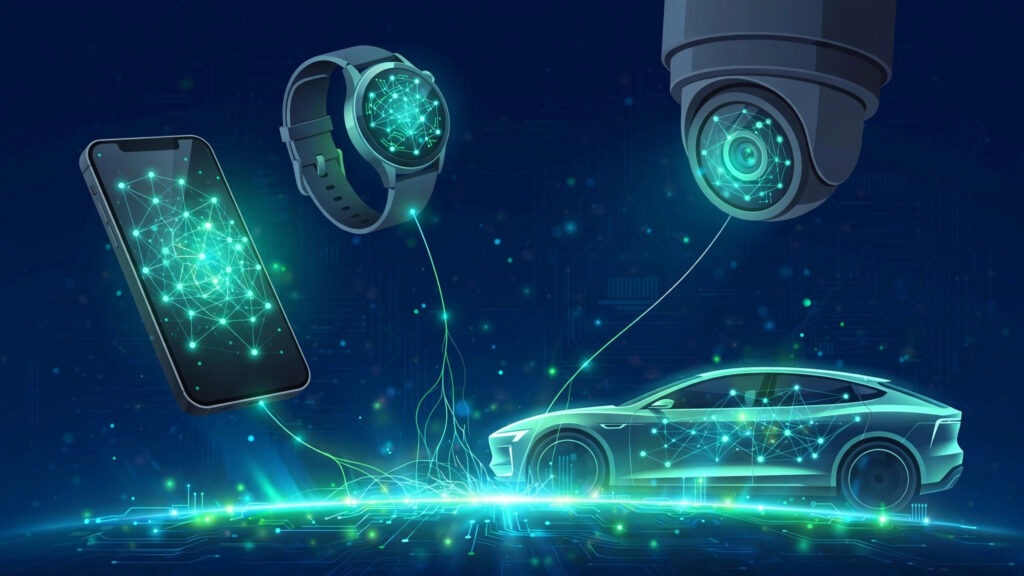
Most AI you use runs in distant data centers — your voice travels to the cloud, gets processed, and comes back. Edge AI explained in one sentence: it moves the intelligence onto the device itself, so phones, cameras, cars, and sensors think locally. The result is AI that is faster, more private, and works without an internet connection.
This is not a niche optimization. As models get smaller and chips get smarter, edge AI is becoming the default architecture for huge categories of applications — the quiet counterpart to the cloud-AI boom.
Edge AI Explained: How It Works Under the Hood
Three advances made edge AI practical. Model compression: quantization shrinks models to 4-bit or even lower precision, pruning removes redundant parameters, and distillation trains small models to mimic large ones — cutting size 10–100x with modest quality loss. Neural processing units (NPUs): modern phones, laptops, and even microcontrollers now ship with dedicated AI accelerators that run neural networks at watts, not kilowatts. Efficient architectures: models designed for the edge (MobileNet, Phi, TinyLlama) deliver remarkable capability per parameter.
The pipeline: train in the cloud on massive data, compress and optimize the model, deploy to devices, and optionally personalize on-device with federated learning — where devices improve the model collaboratively without sharing raw data.
Where Edge AI Is Already Working
- Smartphones: face unlock, computational photography, on-device dictation and translation, live captions — all running locally on your phone’s NPU.
- Automotive: driver-monitoring cameras detect drowsiness, and ADAS systems must react in milliseconds — far too fast for a cloud round-trip.
- Industrial IoT: factory sensors predict equipment failure from vibration patterns; cameras spot defects on production lines in real time.
- Healthcare devices: wearables detect atrial fibrillation and falls; hearing aids use AI denoising — all private, all instant.
- Smart cameras: person detection, package alerts, and license-plate reading happen on the camera, so video never needs to leave your property.
- Retail: shelf-monitoring cameras track stockouts; checkout-free stores fuse sensor data locally.
Edge AI Explained: Latency, Privacy, and Reliability Benefits
Latency: a cloud round-trip takes 100–500ms; on-device inference takes single-digit milliseconds. For autonomous vehicles, industrial safety, and real-time interaction, that difference is the whole application. Privacy: data that never leaves the device cannot be breached in transit, subpoenaed from a server, or used for profiling — a powerful story for health, home, and enterprise data.
Reliability and cost: edge AI works in tunnels, airplanes, factories, and rural areas with no connectivity. And at scale, it flips the economics: instead of paying per API call forever, you pay once for the chip. A million devices each making thousands of daily inferences would bankrupt a cloud-budget — on-device, the marginal cost is near zero.
The Challenges: Constraints and Management
Edge AI trades one set of problems for another. Resource constraints force hard choices: every megabyte of model and milliwatt of power matters. Model updates across millions of heterogeneous devices are an operational challenge — version skew, failed updates, rollback. Security inverts: instead of protecting a data center, you must protect models and data on devices attackers physically possess.
The emerging best practice is hybrid edge-cloud: the edge handles real-time, private, high-volume inference; the cloud handles training, heavy reasoning, and coordination. Intelligence lives wherever it serves the user best.
For developers evaluating edge AI, the tooling has matured enormously. Frameworks like TensorFlow Lite, ONNX Runtime Mobile, and ExecuTorch (PyTorch’s on-device runtime) handle model conversion and optimization, while vendor SDKs — Apple’s Core ML, Qualcomm’s AI Stack, Nvidia’s Jetson platform — squeeze maximum performance from specific chips. The typical workflow: train or fine-tune in the cloud, quantize to INT8 or INT4, benchmark on target hardware (never assume desktop performance translates), and validate accuracy after quantization, since aggressive compression can degrade quality on edge cases. Start with a reference device representing your lowest-spec target — if it runs smoothly there, it runs everywhere. And instrument on-device performance from day one: thermal throttling under sustained load is the surprise that ruins many edge deployments, turning a demo that flies into a product that stutters.
Expect rapid progress here: each chip generation roughly doubles on-device AI performance, steadily moving workloads that once required the cloud onto the device in your pocket.
FAQs
Q: What is edge AI in simple terms?
A: Running AI models directly on devices (phones, cameras, sensors) instead of in cloud data centers — enabling instant, private, offline intelligence.
Q: Is edge AI better than cloud AI?
A: Neither is universally better. Edge wins on latency, privacy, offline operation, and marginal cost; cloud wins on model size, training, and heavy computation. Most systems use both.
Q: What devices run edge AI today?
A: Nearly all modern smartphones, many laptops (via NPUs), smart cameras, wearables, cars, and industrial sensors run AI models locally.
Q: Does edge AI work without internet?
A: Yes — that is one of its defining advantages. Once the model is on the device, inference needs no connectivity at all.

admin
Tech writer at HubTech Fusion covering the latest in technology, from AI to cybersecurity and beyond.
Related Articles

What Is MLOps? A Beginner’s Guide to Machine Learning Operations
Training a model on your laptop is a data science project. Running that model reliably for millions of users, retraining it as…
Best AI Workflow Automation Tools Compared
Workflow automation grew up: it is no longer just “when X happens, do Y.” The best AI workflow automation tools now embed…

Can AI Search Engines Replace Google? An Honest Look
For the first time in 25 years, Google’s dominance feels contestable. Perplexity, ChatGPT Search, Copilot, and a wave of startups promise a…