How AI Is Changing Healthcare: Diagnostics and Drug Discovery
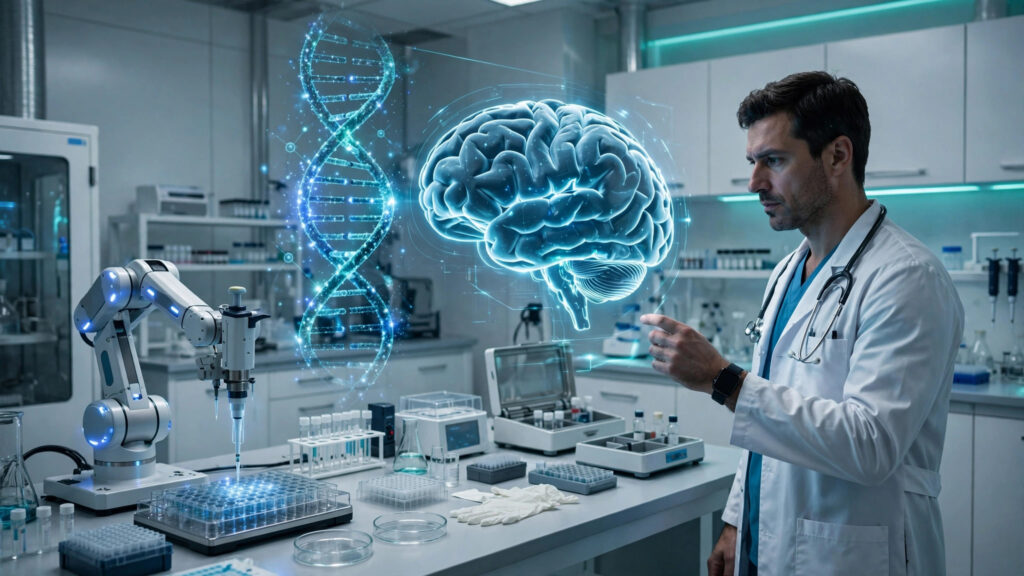
Healthcare generates roughly a third of the world’s data — scans, genomes, clinical notes, trial results — far more than any human team can fully absorb. That is why AI in healthcare is moving fastest in two areas where pattern recognition at scale matters most: diagnostics and drug discovery. Both are shifting from promising pilots to deployed systems with measurable patient impact.
The throughline is not replacing doctors but extending them: AI handles the superhuman-scale pattern matching, clinicians handle judgment, context, and care.
AI in Diagnostics: Seeing What Humans Miss
Medical imaging was AI’s first clinical beachhead, and the results are now well documented. Deep learning models match or exceed specialist performance on specific tasks: detecting diabetic retinopathy in eye scans, flagging lung nodules in CTs, identifying skin lesions, and spotting fractures in X-rays. The FDA has cleared hundreds of AI-enabled devices, many of them radiology assistants that triage scans and highlight regions of interest.
Beyond images, AI reads the signals humans cannot easily quantify. Models detect early Parkinson’s from voice recordings, predict sepsis hours before clinical symptoms from vital-sign trends, and flag cardiac risk from ECGs in ways that surprise even cardiologists. Pathology is a standout: AI analysis of biopsy slides finds subtle patterns correlated with treatment response that the human eye was never trained to see.
The deployment model that works is AI as second reader: the algorithm pre-screens, prioritizes the urgent cases, and the clinician makes the call. This catches things tired humans miss at 2 a.m. without removing human accountability.
AI in Drug Discovery: Compressing Decades Into Years
Traditional drug discovery takes 10–15 years and billions of dollars, with most candidates failing in trials. AI attacks every stage of that pipeline. Target identification: models mine genomic and proteomic data to find proteins linked to disease. Molecule design: generative AI proposes novel compounds optimized for binding affinity, synthesizability, and safety — exploring chemical space far beyond human intuition.
Protein structure prediction was the watershed: systems like AlphaFold solved a 50-year grand challenge, giving researchers instant access to predicted structures for nearly every known protein. That single advance accelerated countless drug programs. Now AI-designed molecules are entering clinical trials — the first real test of whether the lab successes translate into approved medicines.
AI also rescues failed drugs: by matching existing compounds to new disease targets (drug repurposing), models find new uses for shelved molecules at a fraction of new-drug cost and risk.
AI in Healthcare: Barriers Around Regulation, Data, and Trust
Healthcare AI faces constraints other industries do not. Regulation: AI diagnostics need FDA clearance (or equivalent), with evidence of safety and efficacy across diverse populations — a slow, expensive process. Data: medical data is fragmented across systems, inconsistently labeled, and biased toward the populations that generate it; models trained on narrow data can underperform on underrepresented groups.
Trust and liability are the deepest issues. When an AI misses a tumor, who is responsible — the radiologist, the hospital, the vendor? Until liability frameworks clarify, clinicians remain the decision-makers, and rightly so. Explainability matters here: “the model says so” is not an acceptable basis for a diagnosis.
What Comes Next for AI in Healthcare
Watch three frontiers: multimodal clinical AI that fuses imaging, genomics, labs, and notes into unified patient models; AI clinical copilots that draft notes, summarize histories, and suggest differential diagnoses in real time; and personalized medicine where treatment plans are tuned to individual genetic and lifestyle profiles. The technology is largely ready — the work now is validation, integration into clinical workflows, and earning the trust of patients and practitioners alike.
There is also a quieter revolution in AI in healthcare operations that patients never see: models that optimize hospital bed allocation, predict no-shows to reduce wasted appointments, automate prior-authorization paperwork, and flag billing errors. These unglamorous applications may deliver the fastest ROI in the industry because they cut costs without touching clinical decisions — sidestepping the regulatory gauntlet that slows diagnostic AI. For health-system leaders, the pragmatic playbook is to deploy operational AI now for immediate savings while building the validation evidence that clinical AI needs for the long term.
FAQs
Q: Is AI better than doctors at diagnosis?
A: On narrow, specific tasks (like spotting certain lesions in scans), AI can match or exceed specialists. On overall diagnosis — integrating history, context, and judgment — doctors remain essential. The best results come from AI-plus-doctor teams.
Q: Has AI actually discovered a new drug?
A: AI-designed molecules have entered clinical trials, which is a genuine milestone. No AI-designed drug has completed full approval yet — that takes years — but the pipeline is real.
Q: Is my medical data safe with healthcare AI?
A: Regulations like HIPAA govern medical data in the US, and reputable systems use de-identification and strict access controls. Always check how any health app handles your data before sharing it.
Q: Will AI make healthcare cheaper?
A: Eventually, potentially — automation of diagnostics and faster drug development should reduce costs. But healthcare economics are complex, and savings depend on how systems choose to deploy the technology.

admin
Tech writer at HubTech Fusion covering the latest in technology, from AI to cybersecurity and beyond.
Related Articles
What Is MLOps? A Beginner’s Guide to Machine Learning Operations
Training a model on your laptop is a data science project. Running that model reliably for millions of users, retraining it as…

Best AI Workflow Automation Tools Compared
Workflow automation grew up: it is no longer just “when X happens, do Y.” The best AI workflow automation tools now embed…

Can AI Search Engines Replace Google? An Honest Look
For the first time in 25 years, Google’s dominance feels contestable. Perplexity, ChatGPT Search, Copilot, and a wave of startups promise a…